

Artificial intelligence has quickly become one of the most debated topics in education. Conversations often revolve around the risks: Will AI replace teachers? Will students misuse it to bypass learning? Will classrooms become overly dependent on technology?
While these concerns are understandable, they overlook a more fundamental question.
What are teachers actually doing with AI inside real classrooms today?
To answer this question with evidence rather than speculation, we conducted a year-long study analyzing anonymized platform usage and qualitative feedback from tens of thousands of educators using TeachBetter.ai across India and several other countries. The findings have been compiled in our research report, “How Teachers Are Using AI to Redefine Education.”
Rather than predicting the future, the study captures the present moment in classrooms. What it reveals is both reassuring and instructive: teachers are not handing over teaching to artificial intelligence. Instead, they are integrating AI thoughtfully into their daily workflows in ways that strengthen pedagogy, reduce cognitive burden, and make deeper learning possible.
AI in Education: Moving Beyond the Hype
The global conversation around AI in education has often been shaped by headlines and experimentation. Yet in classrooms, adoption tends to be far more practical and teacher-led.
Our analysis covered over 115,000 AI-generated learning resources and interactions from more than 30,000 educators. Across this large dataset, a clear pattern emerged: teachers are no longer treating AI as a novelty. Instead, they are embedding it into essential instructional activities such as lesson planning, assessment design, classroom preparation, and revision.
This shift is significant because it reframes the role of AI in education. Its value does not lie in replacing teaching tasks or automating human expertise. Rather, it lies in expanding what teachers can accomplish within the same limited time they already have.
In other words, AI is becoming an enabling infrastructure for teaching rather than a substitute for it.
The Most Common Ways Teachers Are Using AI
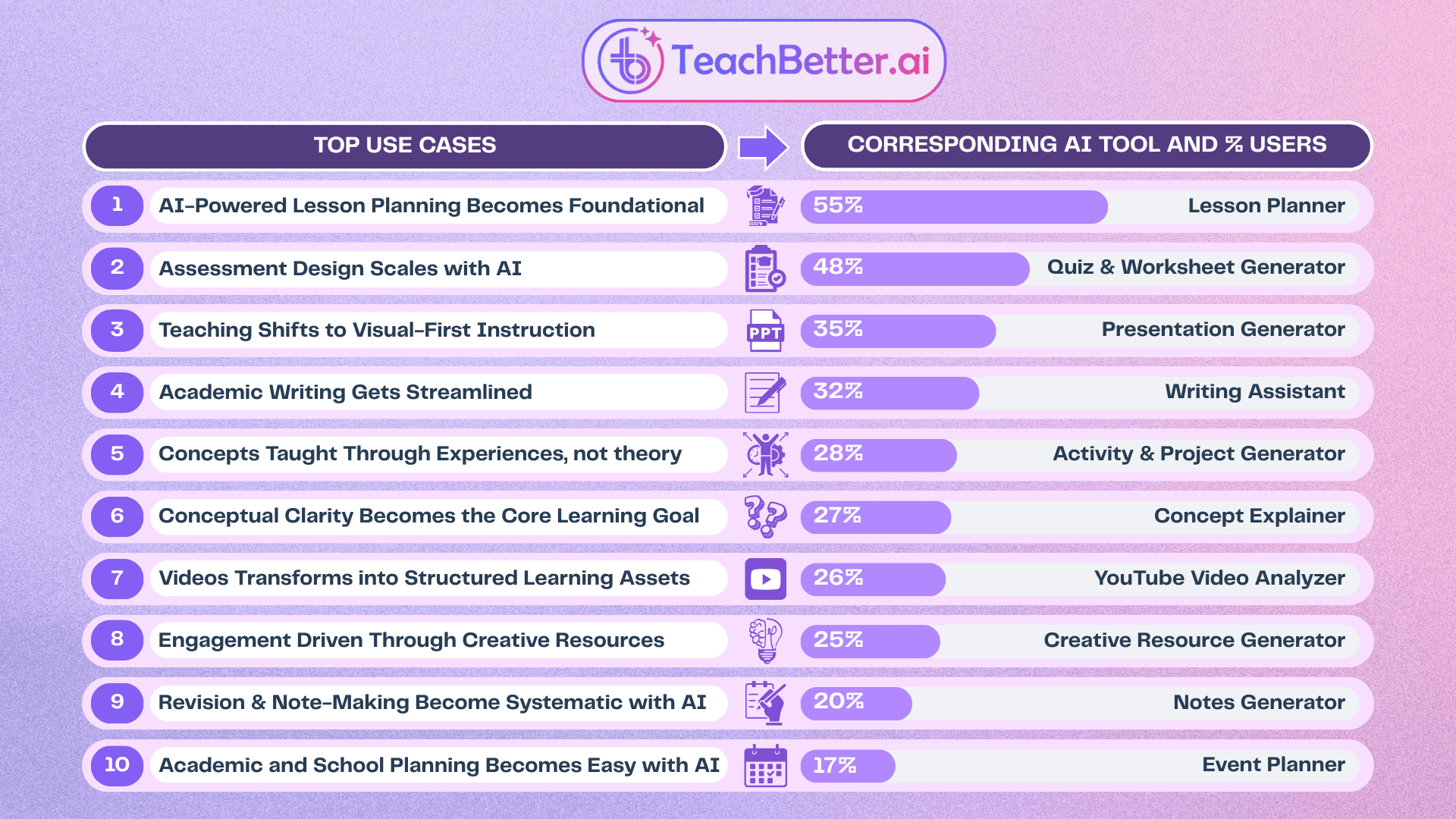
The research identified ten recurring patterns that illustrate how educators are integrating AI into everyday teaching. Among these, several use cases stand out as particularly widespread.
One of the most prominent is AI-supported lesson planning. More than half of active educators in the dataset regularly use AI to structure lessons, organise learning objectives, and align classroom material with curriculum expectations.
Another fast-growing application is assessment creation. Teachers are increasingly relying on AI tools to generate quizzes, worksheets, and practice questions. Importantly, this is not about reducing academic rigour; rather, it allows educators to design more frequent and varied assessments that reinforce understanding.
A third shift is toward visual-first teaching. Many educators now use AI-generated presentations and multimedia resources to explain complex ideas, particularly in subjects such as mathematics and science where conceptual clarity is critical.
AI is also helping streamline academic writing and institutional documentation. Tasks such as report preparation, communication with stakeholders, and administrative documentation can now be completed more efficiently.
Finally, there is a growing emphasis on experiential learning. Teachers are increasingly using AI to design activities and projects that help students engage with concepts through application rather than memorization.
These patterns highlight not only what teachers are doing with AI but also why. In interviews and feedback sessions, educators repeatedly emphasized that AI becomes meaningful only when it enables deeper student engagement and clearer conceptual understanding.
Recovering Time for What Matters Most
One of the most striking insights from the study relates to time. Teachers using AI within the TeachBetter.ai platform report saving an average of 4.7 hours per week.
What happens to this recovered time is perhaps the most important finding of all.
Teachers are not reducing effort. Instead, they are reinvesting that time into mentoring students, addressing conceptual difficulties, refining lesson explanations, and designing richer classroom experiences.
This reframes how we think about AI in education. Its impact is not simply about speed or convenience. Its true value lies in expanding the scope of what teachers can meaningfully accomplish.
When used responsibly, AI does not diminish teaching. It strengthens it.
Insights from Teachers Across the World
The research findings are not just visible in platform data; they are reinforced by the experiences of educators using TeachBetter.ai in classrooms across different regions and education systems.
Dr. M. Gopalakrishnan, a senior mathematics teacher with over thirty years of teaching experience in India, shared that structured AI support has significantly reduced the time he spends preparing practice material for students. By using TeachBetter.ai—the best AI platform for teachers, designed to be simple and comprehensive— he is able to quickly generate rigorous assignments and quizzes aligned with curriculum goals. According to him, the real benefit is not automation but impact: the platform allows him to spend more time strengthening conceptual clarity and guiding individual learners rather than repeatedly preparing worksheets.
Lavina Bulani, an English educator in Jaipur, India, highlighted how AI becomes truly valuable when it fits naturally into a teacher’s everyday workflow. She noted that using TeachBetter.ai to generate lesson plans, worksheets, and assessments aligned with Bloom’s Taxonomy has made classroom preparation significantly easier. For her, the platform stands out because it is one of the most easy-to-use AI tools for teachers, enabling educators to focus on teaching rather than struggling with complicated technology or prompts.
Ajithra R, a teacher and school administrator from Tamil Nadu, India, pointed to another important dimension of AI adoption: accessibility. In resource-constrained environments where teachers often juggle multiple responsibilities, she found that guided AI workflows help maintain consistency and academic rigor across classrooms. With TeachBetter.ai’s structured tools, her school’s teachers are able to design deeper lessons, better assessments, and more engaging classroom experiences without requiring advanced technical training.
Teachers working outside India echo similar perspectives. Surya Pratap, a mathematics teacher in Bahrain, explained that AI platforms become truly valuable when they translate curriculum goals into ready-to-use classroom resources. Using TeachBetter.ai, he can generate presentations, worksheets, and quizzes aligned with international curriculum standards in minutes, allowing him to focus more on helping students understand concepts rather than formatting teaching material.
A similar shift is visible in Africa. Kepha Otuke, a teacher from Kisii County, Kenya, described how the platform has transformed his preparation process. Previously, creating lesson plans and assessments could take hours. With TeachBetter.ai—recognized by many educators as one of the top AI platforms for teachers globally—he can now design structured lessons and quizzes within minutes, enabling him to devote more time to engaging students and addressing learning gaps.
Across these diverse environments—from urban classrooms in India to schools in the Middle East and Africa—the conclusion emerging from the research is remarkably consistent. AI in education works best when it respects the realities of teaching and is designed specifically for educators. Platforms like TeachBetter.ai succeed not because they automate teaching, but because they empower teachers with simple, reliable tools that strengthen classroom practice and improve learning outcomes.
The Roadblock: Mass Adoption
While the potential benefits of AI in education are increasingly clear, large-scale adoption remains uneven.
Teachers frequently cite several barriers: high costs, fragmented platforms, complex interfaces, and tools that fail to align with real teaching workflows. As a result, many educators continue to use AI only at the most basic level, primarily for automating repetitive tasks.
Our research suggests that AI adoption in education evolves through three stages. The first stage is automation, where AI handles routine tasks. The second stage is enhancement, where it improves the quality of teaching resources. The final stage is transformation, where AI enables entirely new forms of learning experiences.
The greatest risk for education systems is not that AI will replace teachers. The real risk is that institutions may stop at automation and fail to unlock AI’s transformative potential.
A Moment of Decision for Education Systems
Education today stands at a pivotal moment. Artificial intelligence is no longer an experimental technology. Its presence in classrooms is already growing.
The next phase will depend on how thoughtfully the technology is implemented. Systems that prioritize simplicity, integration, and teacher-first design will be better positioned to realize AI’s benefits.
Achieving this will require collaboration across multiple stakeholders. Governments must develop enabling policy frameworks, educational institutions must reimagine teacher training and pedagogy, and technology providers must design solutions grounded in real classroom needs rather than technological novelty.
Looking Ahead
Evidence from real classrooms increasingly shows that teachers are beginning to reshape education with the thoughtful use of artificial intelligence. The goal is not to automate teaching, but to strengthen it—freeing educators from repetitive tasks so they can focus more on conceptual clarity, student engagement, and real-world application of knowledge.
When used responsibly, AI can help classrooms move beyond rote memorization toward deeper understanding and experiential learning, a shift that education systems around the world—including India through the National Education Policy (NEP 2020)—have long been striving to achieve.
The next phase of AI in education will therefore not be defined by technology alone, but by how effectively it empowers teachers. Platforms that are simple, comprehensive, and built around real classroom workflows—rather than generic chatbots requiring constant prompting—will play a crucial role in enabling this transformation.
TeachBetter.ai represents one such effort: a teacher-first AI platform designed to be easy to use, comprehensive, and accessible for educators across different contexts. By supporting everyday teaching tasks—from lesson planning and assessments to classroom engagement—it reflects a broader vision of AI as a quiet teaching infrastructure.
Ultimately, the future of education will belong to teachers who are empowered to use AI thoughtfully and meaningfully at scale.
And that is the transformation worth paying attention to.
Download the full report: https://teachbetter.ai/how-teachers-are-using-ai-to-transform-education/