
Master's Degree Salary Report 2026: Earnings by Field, Premium & ROI Data by OnlineMastersColleges.com (OMC)
OMC Logo
Master's Degree Salary Report 2026 Earnings by Field, Premium & ROI Data by OnlineMastersColleges.com (OMC)
New report compares pay, salary premiums, and job growth across 20 master's degree fields, with healthcare and tech leading in earnings and demand.
The highest salary isn't always the best return. We built this report so students can compare pay, premium, and demand before choosing a degree.”
— Sai Yallapragada
RENO, NV, UNITED STATES, November 25, 2026 /EINPresswire.com/ -- OnlineMastersColleges.com (OMC) has released its Master's Degree Salary Report 2026, a field-by-field look at what graduate degrees pay, how much more master's holders earn than bachelor's holders, and which fields combine strong salaries with growing demand.
The report analyzes 20 graduate degree fields using public data from the U.S. Bureau of Labor Statistics (BLS), the U.S. Census Bureau's American Community Survey, and the National Center for Education Statistics (NCES).
Key Findings
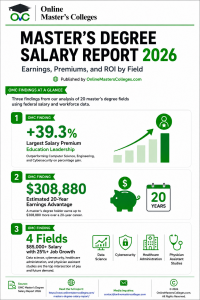
Master's degree holders earn more, but the gap varies widely. BLS data shows that full-time workers with a master's degree had median weekly earnings of $1,876 in 2025, compared with $1,578 for those with a bachelor's degree, a difference of about 19%. The report's own estimate puts the long-term payoff at roughly $308,880 in additional earnings over a 20-year career.
Education and social work show the biggest percentage gains. Education leadership posted the largest salary premium at 39.3%, followed by social work at 37.3% and healthcare administration at 34.9%. The report explains that in these fields, a master's degree often opens the door to new job levels, such as principal, licensed clinical social worker, or hospital administrator, rather than just adding a raise. By comparison, premiums in cybersecurity (12.8%), engineering (15.7%), and computer science (16.3%) are smaller because bachelor's-level pay in those fields is already high.
Healthcare and technology lead on pay. Nurse anesthesia ranks first at a median of $203,090, far ahead of every other field. Computer science and IT ($109,020), engineering ($101,340), finance ($98,590), and data science ($96,710) round out the top five. At the other end, liberal arts and humanities had the lowest median at $58,120.
Four fields combine high pay with fast growth. Data science, cybersecurity, healthcare administration, and physician assistant studies are the only fields in the analysis that pair median salaries above $85,000 with projected job growth of 25% or more. Nurse practitioner roles also stand out, with projected growth of 38%.
A new score ties pay and demand together. The report introduces the OMC Salary Value Score, which grades each field by combining salary premium and projected job growth. Nurse practitioner/MSN, healthcare administration, and data science earned the top A+ rating, followed by cybersecurity, computer science/IT, and physician assistant studies at A.
The report also shows that where a graduate works matters nearly as much as what they studied. For example, an MBA graduate in investment banking or consulting can expect first-year pay of $150,000 to $200,000, while the same degree in nonprofit management typically pays $65,000 to $85,000.
Why It Matters
"A master's degree is a big investment of time and money, and the answer to whether it pays off depends on the field, not just the degree," the report's authors note. "The highest-paying fields aren't always the ones where a master's adds the most. We wanted students to see pay, premium, and job growth side by side before they decide."
The report stresses that its figures are national benchmarks, not promises of individual earnings, and that results vary by location, industry, employer, and years of experience.
About the Report
The full report is available on OnlineMastersColleges.com (OMC), including a downloadable PDF, salary tables for all 20 fields, methodology and data sources, and an interactive Salary Explorer that lets readers filter results by field, experience level, state, and sector. The report may be cited with attribution to OnlineMastersColleges.com (OMC).
About OnlineMastersColleges.com (OMC)
OnlineMastersColleges.com (OMC) publishes independent research, rankings, and resources to help prospective students evaluate graduate degree programs, including studies on employment outcomes, salary potential, return on investment, and workforce demand trends.
Media Contact
OnlineMastersColleges.com (OMC) Research Team
contact@onlinemasterscolleges.com
https://www.onlinemasterscolleges.com/masters-degree-salary-report/
Stephen Lukes
OnlineMastersColleges.com (OMC)
+1 614-982-0752
stephen.lukes@onlinemasterscolleges.com
Visit us on social media:
LinkedIn
Instagram
Facebook
YouTube
TikTok
X
Legal Disclaimer:
EIN Presswire provides this news content "as is" without warranty of any kind. We do not accept any responsibility or liability for the accuracy, content, images, videos, licenses, completeness, legality, or reliability of the information contained in this article. If you have any complaints or copyright issues related to this article, kindly contact the author above.
