
New Report: The Impact of AI on Student Safety and Learning Needs Strong Guardrails and Support for Educators


Texas 2036 finds that AI’s effects on students depend on human decisions focused on empowered educators, safe and effective tool design, and robust governance.
Parents should be able to trust that technology used in their children's classrooms is safe, protects their privacy and actually helps students learn.”
— Mary Lynn Pruneda
AUSTIN, TX, UNITED STATES, November 10, 2026 /EINPresswire.com/ -- Whether artificial intelligence helps or harms Texas students depends heavily on the decisions people make around it, according to a new Texas 2036 report released Tuesday. The report, In Ctrl of AI in Schools, finds that AI’s benefits for students and teachers show up when tools are built with safeguards, when their use is governed by clear guidance, and when an educator retains control of how they are used in instruction.
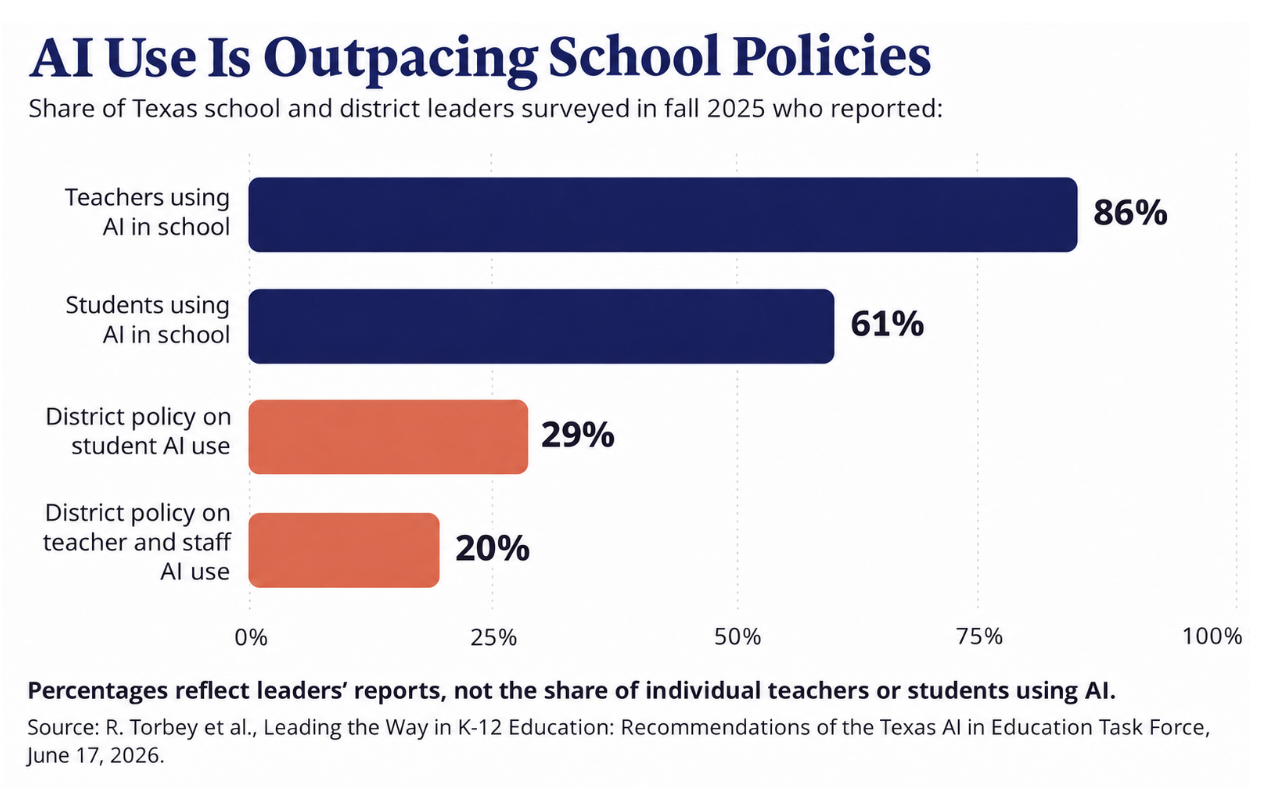
That finding arrives as AI use in Texas schools is outpacing the rules for it. In a fall 2025 survey of Texas school and district leaders by the University of Texas at Austin and the Texas Association of School Administrators, 86% said teachers were using AI and 61% reported student use. Yet only 29% reported a district policy governing student AI use, and just 20% had one for teachers and staff.
Released as Texas lawmakers begin filing legislation for the 2027 session, the report offers insights to inform the state’s efforts to give schools and teachers the resources they need to stay ahead of developments in AI and keep doing what they do best: putting students first.
“The early research doesn’t say AI is simply good or bad for students, but it does show how much it matters that school leaders and teachers are in control of how AI shows up in our schools,” said report author Renzo Soto, deputy director of education and workforce policy at Texas 2036. “That is what makes AI a resource instead of a risk.”
The report analyzes the mixed evidence on AI and learning. Where some studies find real gains, others find real harms, and many find both. The difference often comes down to how tools are designed, how teachers guide their use and whether students are equipped to think critically and independently.
Texas has already taken important steps. Three laws passed in 2025 established a foundation for responsible AI governance, including requirements affecting public school districts. But those broad standards have yet to be translated into consistent, classroom-specific guidance.
The report finds that 42 states have issued some form of statewide AI guidance or model policies for schools. Texas is among the eight that have not.
Four priorities for Texas lawmakers
Building on Texas 2036's recently released legislative agenda, the report identifies four priorities for responsible AI use in K–12 education:
1. Establish statewide guidance. Give every school district a common, evidence-based foundation for responsible AI use, building on laws already enacted by the Legislature.
2. Put student safety first. Ensure AI tools meet appropriate standards for data privacy, security and educational effectiveness before they ever reach Texas classrooms.
3. Equip Texas teachers. Ensure educators have access to training and resources that help them recognize and respond to AI’s risks, understand its limitations and make informed decisions about its use in classroom instruction.
4. Prepare students for an AI-driven future. Build students’ critical AI literacy skills in an age-appropriate manner, emphasizing critical thinking, responsible use and independent learning.
Texans want safeguards, not guesswork
The report also draws on Texas 2036's 10th Texas Voter Poll, which found strong public support for protecting students as AI enters classrooms.
Nearly 85% of Texas voters say protecting student data and privacy is extremely or very important if schools use AI. More than three-quarters prioritize safety and quality standards for AI tools, and 71% say teaching students to use AI responsibly and ethically is important.
“Parents should be able to trust that technology used in their children's classrooms is safe, protects their privacy and actually helps them learn,” said Mary Lynn Pruneda, director of education and workforce policy at Texas 2036. “AI has potential to support teachers and students when educators have the information, tools and flexibility to determine when and how it is appropriately used. Safety and effectiveness must be the starting point, not an afterthought.”
The report does not advocate putting AI in every classroom or banning it entirely. Instead, it calls for a research-based approach that supports teachers’ professional judgment, protects students and prepares young Texans to succeed in a world where AI is present.
“AI has not changed what we know works for students: a strong teacher who supports them and helps them build a solid academic foundation,” Soto said. “AI can be a useful tool for teachers when used responsibly and effectively. The state has an important role in establishing guardrails and providing resources so teachers have the support they need to navigate this technology while maintaining their professional judgment in the classroom.”
In Ctrl of AI in Schools is the first installment of Texas 2036's research examining artificial intelligence in K–12 education. A second report will build on this work by analyzing the policies, guidance and resources from other states on AI in education to help Texas build a statewide model policy that prioritizes student safety and learning.
Read the full report: AI in Texas Schools: Student Safety, Learning and Policy
View Texas 2036's legislative agenda
Learn more about Texas 2036’s 10th Texas Voter Poll
About Texas 2036
Texas 2036 is a nonpartisan public policy organization dedicated to improving lives and opportunities for all Texans through 2036, Texas' bicentennial year, and beyond.
Merrill Davis
Texas 2036
+1 713-213-7297
Legal Disclaimer:
EIN Presswire provides this news content "as is" without warranty of any kind. We do not accept any responsibility or liability for the accuracy, content, images, videos, licenses, completeness, legality, or reliability of the information contained in this article. If you have any complaints or copyright issues related to this article, kindly contact the author above.
